
Different Clothes. Same Human Hunger.
When a single moment reveals, there is more to be seen.
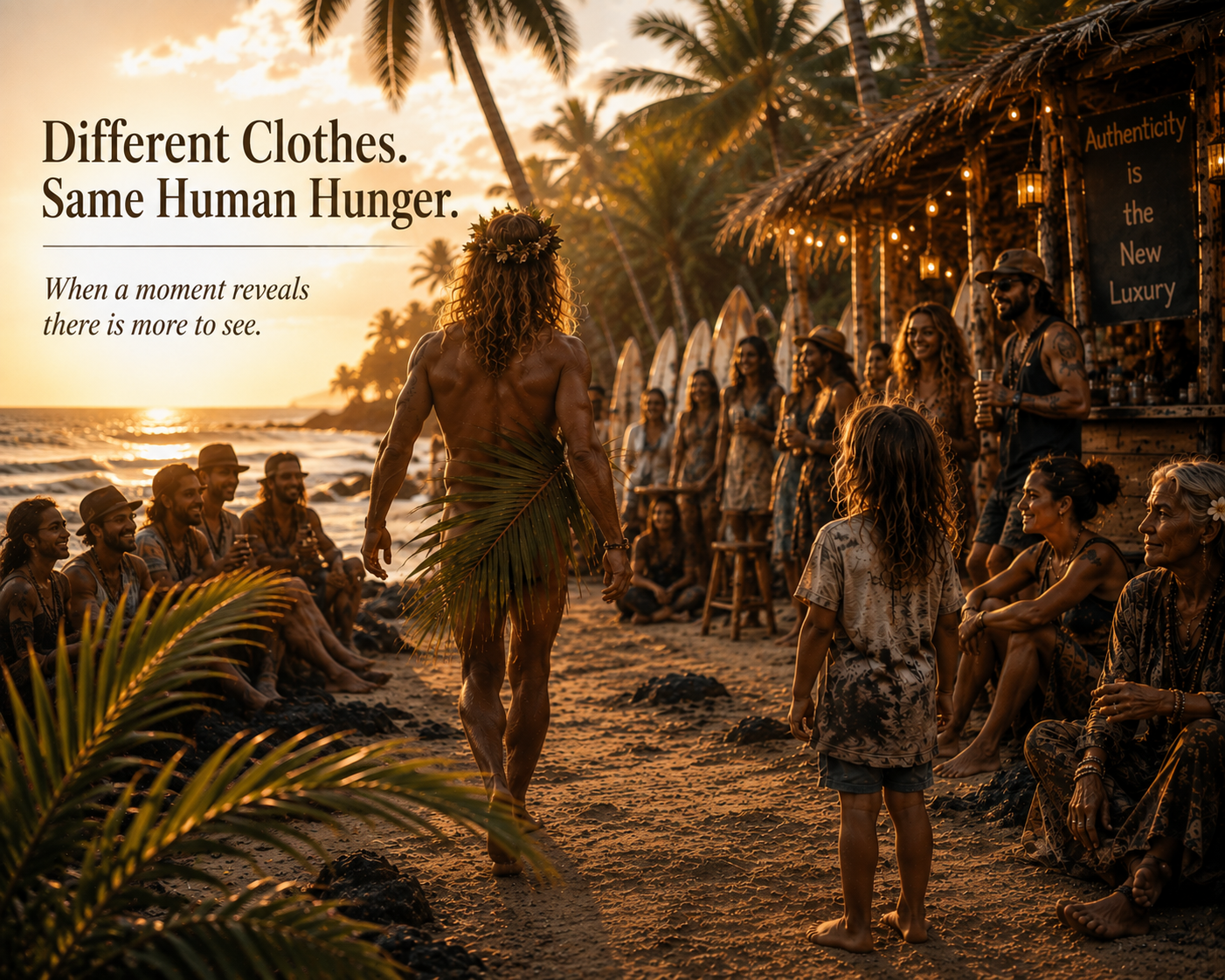
When a moment reveals there is more to see.
Do you remember, as a child, the story of The Emperor's New Clothes?
I'm starting to realize that so many of these old fables—alongside the wisdom tucked inside Aesop's stories—were far more sly than we ever gave them credit for.
They weren't just stories for children.
They were little mirrors.
Quietly teaching us how to see the world.
How to recognize human nature.
Maybe even how to remain childlike.
Not childish.
Childlike.
Because children, before they are conditioned by the world around them, often notice what adults have learned to overlook.
They haven't yet invested in the illusion.
They haven't learned all the reasons they're supposed to stay quiet, play along, or protect the story everyone else has agreed to.
Maybe that's why these stories endure.
Buried inside them are lessons about ego, identity, illusion, and the quiet courage to see things as they are.
The brilliance of The Emperor's New Clothes is that the Emperor wasn't the only one fooled.
Everyone participated.
The Emperor wanted so badly to be seen as discerning, exceptional, above the ordinary.
So the invisible clothes worked because they appealed to the identity he already carried.
They made him feel elevated.
And everyone else reinforced the illusion.
Not necessarily because they were malicious.
Because they were afraid.
Nobody wanted to be the one who said,
"Uh... guys... he's literally naked."
Sometimes we don't actually escape the old systems.
We just change the costume.
The person who once chased status may become the person chasing enlightenment.
The person who once needed validation through achievement may now need validation through being "more conscious."
The person who once said,
"Look at what I have,"
may now say,
"Look at how awakened I am."
Different clothes.
Same human hunger.
Maybe that's what happens when authenticity becomes a trend.
We start performing the very thing we were searching for.
We build an identity around being authentic.
We escape one box only to decorate another.
The person who has awakened to their patterns can still become attached to being the one who sees patterns.
The person who recognizes there is no final arrival can still quietly create a destination called awareness.
Maybe that's the humbling paradox of growth.
The further you go, the more you realize there is nowhere to arrive.
The more you learn, the more you realize how much you don't know.
The more you evolve, the less interested you become in proving that you have evolved.
Even that realization can become another costume.
And that's where the child enters the story.
The child wasn't enlightened.
He wasn't more evolved.
He simply hadn't joined the agreement.
He looked.
And he said what he saw.
There was no status to protect.
No identity to defend.
No tribe to impress.
That's why I think the distinction between childlike and childish matters.
Childish wants the world to bend around itself.
Childlike simply meets the world.
Childish grasps.
Childlike wonders.
Maybe the deepest evolution isn't becoming some elevated version of ourselves.
Maybe it's returning to something we knew before we learned to perform.
Before we learned who we were supposed to be.
Before we became invested in the image of ourselves.
The child didn't need a new box.
He didn't need a better costume.
He simply looked.
Maybe that's the wildness we keep searching for—not the rebellion of refusing every structure, but the innocence of seeing clearly enough that we no longer need to pretend.
The child in The Emperor's New Clothes isn't the enlightened one.
He isn't standing above the crowd with special knowledge.
He is simply unburdened by the agreement.
And that distinction matters.
The moment we make the child the wise one and everyone else the unconscious ones...
we've created another hierarchy.
Another invisible outfit.
The wisdom isn't becoming the child.
It's remembering the part of ourselves that could still see before we learned to perform.
Of course, even that can become another costume.
We can wear innocence.
We can wear freedom.
We can even wear humility.
Funny what the mind does.
Eventually, it tries to turn almost everything into an identity.
The moment we believe we have arrived...
we've simply found somewhere else to get stuck.
Awareness isn't about escaping being human.
It's about becoming honest enough to look.
Ashe,
Your Wahine of the Sun
