
The Instinctual Woman
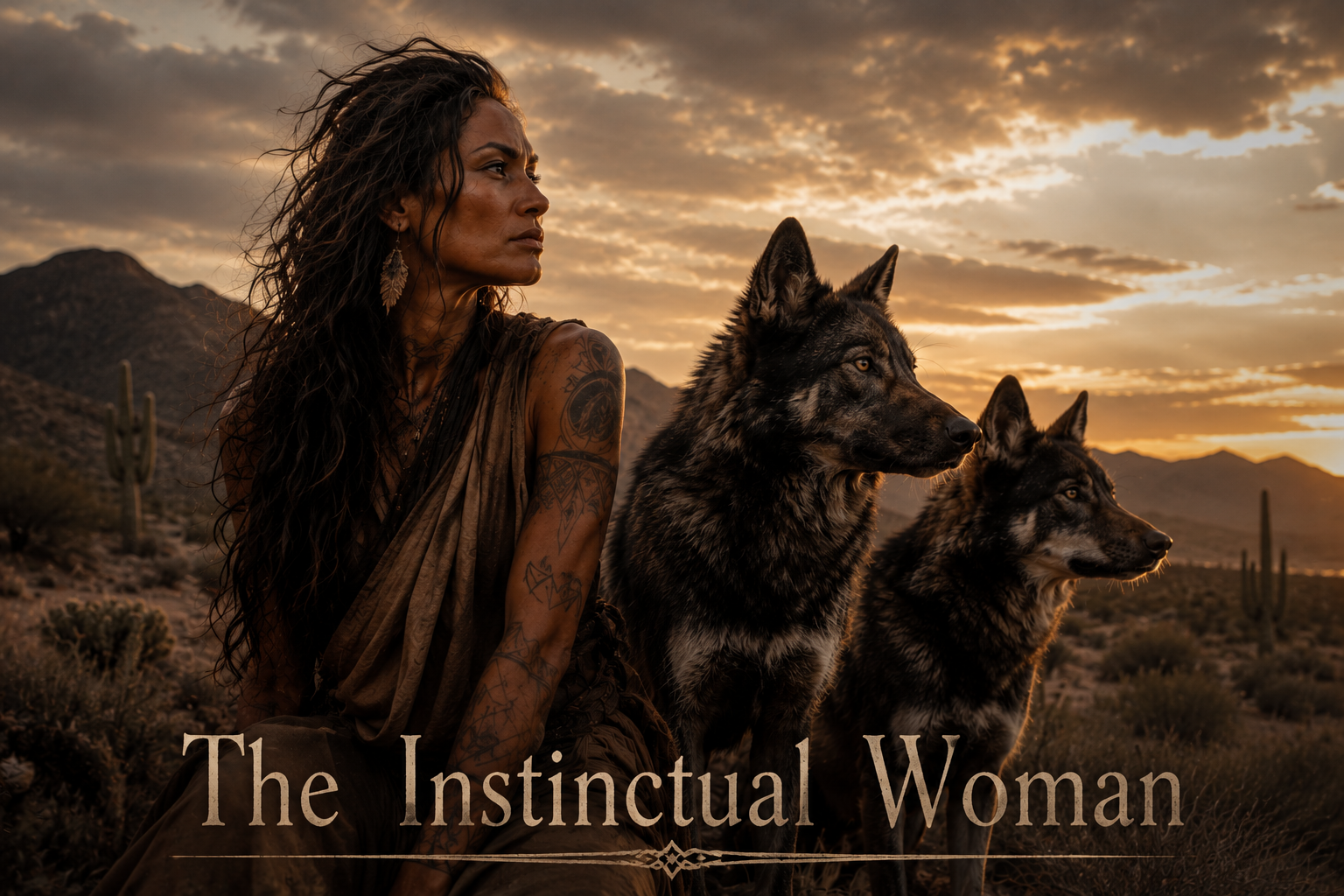
The Instinctual Woman
Instinct, Intuition, and the Rehabilitation of Wildness
A compass ignored does not cease to exist.
It simply becomes difficult to read.
Perhaps no intelligence has been more systematically ignored than instinct.
We speak often of intuition, yet rarely of instinct.
Perhaps because instinct is harder to domesticate.
Intuition has become fashionable. It appears in books, podcasts, morning rituals, and social media captions. We are encouraged to trust it, follow it, strengthen it.
Yet few pause to ask what intuition actually is.
Or where it comes from.
Instinct, on the other hand, receives far less attention.
Perhaps because instinct cannot be packaged quite so neatly.
Instinct belongs to nature.
It is what turns the herd before the storm arrives.
It is what sends birds across oceans they have never crossed before.
It is what teaches roots to seek water hidden beneath the earth.
Nature does not deliberate its way into wisdom.
It remembers.
Instinct is the intelligence of nature.
Intuition is our conscious experience of that intelligence.
One lives beneath awareness.
The other rises into it.
They are not separate so much as different expressions of the same current.
Yet somewhere along the way, we became suspicious of this intelligence.
We have been taught to trust experts before experience.
Logic before sensation.
Consensus before knowing.
We are educated out of our bodies and rewarded for living from the neck up.
Then we wonder why so many feel anxious, disconnected, uncertain, and perpetually lost.
A compass ignored does not cease to exist.
It simply becomes difficult to read.
This is where the conversation often becomes distorted.
A woman senses something is off.
She notices a subtle shift.
A contradiction.
An inconsistency.
A truth that has not yet revealed itself fully.
And what does she hear?
You're overthinking.
You're too emotional.
You're reading into things.
You're imagining it.
Too sensitive.
Too much.
Generation after generation, women have received some variation of the same message:
Distrust yourself.
Question your knowing.
Look outward for confirmation.
Yet intuition is not the same thing as emotional reactivity.
It is not anxiety.
It is not projection.
It is not fear wearing a spiritual costume.
Intuition emerges from a deeper place.
It is rooted in instinct.
And instinct is not emotional.
It is biological.
Ancient.
Natural.
A deer does not overanalyze the presence of a predator.
A flock of birds does not hold a committee meeting before changing direction.
Life responds to life.
Nature recognizes itself.
Something within us does as well.
Living beside our young wolf pups has made this impossible for me to ignore.
They wrestle through the desert with unmistakable joy, yet nothing about their awareness ever goes offline.
While they play, they are still reading the wind.
Still tracking scent.
Still scanning the landscape.
If one of them falls behind, the others stop and wait.
They recognize potential danger without becoming ruled by it.
There is no hesitation.
No endless negotiation.
No second-guessing what their bodies already know.
Their instinct is not something they occasionally consult.
It is the relationship through which they move.
Watching them has made me wonder if instinct is less some mysterious gift than an unbroken relationship with our own nature.
Perhaps that relationship is what we've forgotten.
Humans hesitate because we have been conditioned to doubt what nature responds to without hesitation.
We have learned to question the very intelligence that has quietly carried life for millions of years.
Over time, hesitation becomes habit.
Habit becomes identity.
And our internal compass becomes harder to read.
Not because it stopped speaking.
Because another voice took root.
Like a weed slowly overtaking a flourishing garden, conditioning grows over instinct until we mistake the overgrowth for the landscape itself.
The tragedy is not that we have lost this capacity.
The tragedy is that we have learned to distrust it.
And that distrust is one of the primary consequences of domestication.
Domestication is often mistaken for civilization.
But they are not necessarily the same thing.
A domesticated animal learns to suppress certain instincts in exchange for approval, safety, and belonging.
Humans are not exempt from this process.
We learn which parts of ourselves are welcome.
Which emotions are acceptable.
Which truths are safe to speak.
Which desires are appropriate.
Which instincts should be ignored.
We learn to perform.
To accommodate.
To comply.
To fit.
Eventually the performance becomes so familiar that we mistake it for identity.
Yet nature remains remarkably patient.
The river never forgets how to flow.
The seed never forgets what it is becoming.
The migrating bird never forgets the sky.
And the wild within us never truly disappears.
Wildness has been deeply misunderstood.
Many hear the word and imagine recklessness.
Chaos.
Irresponsibility.
A rejection of structure.
But true wildness is none of those things.
The forest is wild.
Yet it operates through extraordinary intelligence.
The ocean is wild.
Yet it moves according to rhythms older than humanity itself.
Wildness is not disorder.
Wildness is authenticity.
It is life expressing itself according to its own nature.
A wolf is wild because it is fully wolf.
An oak is wild because it is fully oak.
A river is wild because it remains faithful to its own course.
And a human being is wild when they are fully themselves.
Not performing.
Not pretending.
Not contorting themselves into shapes that earn approval while costing them their aliveness.
This is why wildness and joy are so intimately connected.
Not because life becomes easier.
But because energy is no longer consumed by maintaining a false self.
There is immense relief in no longer negotiating against your own nature.
The instinctual woman understands this.
She is not seeking permission to become someone new.
She is remembering what has always been there.
Beneath the conditioning.
Beneath the roles.
Beneath the expectations.
Beneath the endless demands to do.
To perform.
To achieve.
To conform.
She is rediscovering the intelligence that existed before anyone told her who she should be.
And perhaps that is the invitation.
Not self-improvement.
Not reinvention.
Not becoming.
Remembering.
Because instinct is not extinct.
Wildness is not extinct.
Nature is not extinct.
They wait patiently beneath the layers of domestication, like embers beneath ash.
The question is not whether they are still there.
The question is this:
If the voice you've called your own for years is largely the product of conditioning, expectation, and adaptation—
what might your life sound like when your true nature finally speaks?
Ashe,
Your Wahine of the Sun
