
The Ecology of Love
Medicine in the Margins // No. 2
The Ecology of Love
How masculine and feminine flourish—and fracture—in relationship.
Medicine in the Margins // No. 2
The Ecology of Love
How masculine and feminine flourish—and fracture—in relationship.
I've never seen a forest ask one tree to hold up the entire ecosystem.
Nature doesn't work that way.
The river needs its banks.
The hawk needs the thermal.
Roots need rain.
Fire clears what can no longer sustain life, and water cools what has burned too long.
Every living system depends upon relationship.
Maybe love does too.
Nature is built upon complementary forces.
The mountain stands.
The valley receives.
The river moves.
The banks give it shape.
Roots reach downward while branches reach toward the light.
The tide advances.
The shore receives.
Neither exists to compete with the other.
Neither is complete in isolation.
Each allows the other to become more fully itself.
There are archetypal currents like this woven throughout the natural world, and I believe they exist within us as well, because we are living expressions of nature itself.
Across cultures, across generations, people have given them different names.
Masculine.
Feminine.
Yang and yin.
Sun and moon.
Not as rigid identities.
Not as prisons.
But as living qualities that, at their healthiest, exist in relationship.
To me, a grounded masculine often expresses itself through presence, protection, steadiness, direction, and strength in service of life.
A healthy feminine often expresses itself through receptivity, tenderness, intuition, nurturing, and the extraordinary capacity to cultivate life—in relationships, in families, in communities, and within herself.
These are not performances.
They are not obligations.
They are archetypal expressions that tend to emerge when the conditions are right.
Which is why I've always found it curious that so much of today's conversation asks us to cultivate these qualities as though they exist in isolation.
"Stay in your feminine."
"Step into your masculine."
Nature has never worked that way.
A river without its banks eventually loses its direction.
The banks without the river simply become dry earth.
Everything living is shaped by relationship.
Why would we imagine human beings are any different?
Before anyone misunderstands me, I don't believe men own masculinity or women own femininity.
Every one of us carries both.
The capacity to protect.
The capacity to nurture.
To lead.
To receive.
To hold.
To soften.
To build.
To surrender.
They're all human.
And yet there is something undeniably beautiful that often unfolds when a man is deeply rooted in his grounded strength and a woman feels safe enough to rest into her tenderness.
Not because either one is playing a role.
Because neither one has to.
Nature doesn't force a flower to open.
It creates the conditions where opening becomes possible.
That distinction changes everything.
Because when those conditions begin to fracture...
people adapt.
Not because they're weak.
Because they're alive.
I've watched women become harder than they ever wanted to be.
Not because they forgot how to love.
Because somewhere along the way, love stopped feeling safe.
Tenderness built walls.
Receptivity became vigilance.
Softness learned to carry a sword.
I've watched men do the same.
Strength became control.
Protection became hypervigilance.
Presence became withdrawal.
Not because masculinity failed.
Because survival quietly took the steering wheel.
They simply adapted to the weather they were living in.
The internet loves to ask,
"Who's in their masculine?"
"Who's in their feminine?"
I find myself asking a different question.
What happened that made their nervous systems stop trusting the environment they were standing in?
Even when that current environment may no longer be asking them to survive.
The answer isn't always found in the present.
Sometimes the present is simply where the past finally echoes loud enough for us to hear it.
And then sometimes the answer is found in the relationship we're standing in.
This is where our awareness of self allows for greater insight.
Long before we ever meet one another, our nervous systems have already been quietly collecting evidence.
Childhood.
Past loves.
Betrayal.
Abandonment.
Joy.
Safety.
Loss.
Each experience leaves its impression.
Layer upon transparent layer.
Until, without realizing it, we begin seeing the present through unfinished stories from the past.
I think we've all done this.
Expected someone to pay a debt they never incurred.
Protected ourselves from a danger that wasn't actually in front of us.
Blamed the person we were with for wounds they didn't create.
Not because we're cruel.
Because our nervous systems were trying to keep us alive.
Somewhere along the way, we stopped seeing the person standing before us for who they are and began seeing them through transparent layers left behind by someone else.
That's where the riverbanks begin to erode.
Not because love disappeared.
But because memory quietly began speaking louder than reality.
This is why I don't see healing as another self-improvement project.
Or another mountain we're supposed to climb until we're finally worthy of love.
Healing is another gateway to freedom.
True freedom.
Not because it erases what happened.
But because it slowly removes the transparent layers that keep yesterday from becoming today's reality.
It allows us to meet the person standing in front of us...and ourselves more truthfully
...instead of the memory standing behind us.
I can't think of a greater gift we can offer another human being.
Or ourselves.
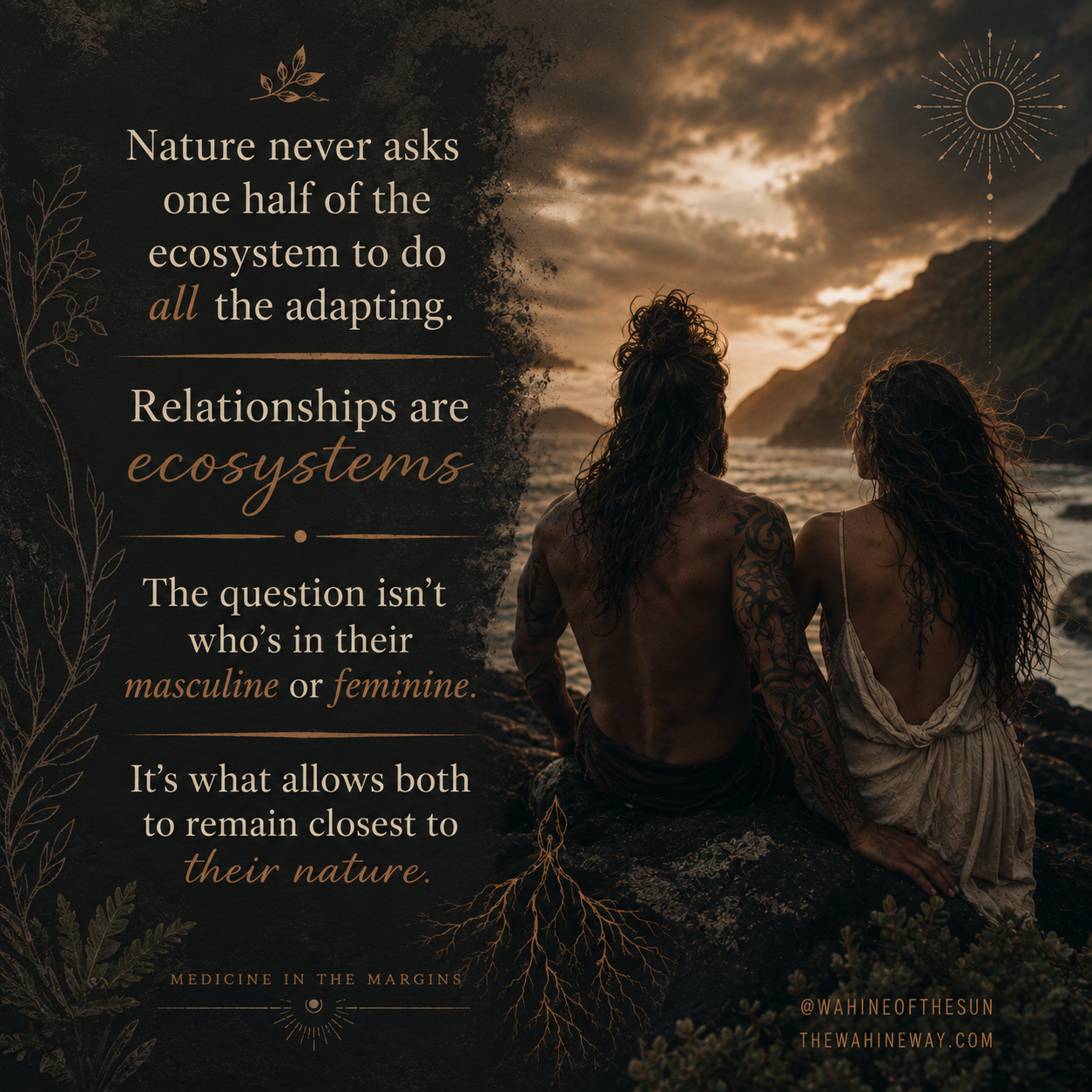
Relationships are ecosystems.
The ones we have with others, and most importantly, the relationship we have with ourself.
Each nervous system is constantly speaking to the other.
Not through words.
Through presence.
Through consistency.
Through repair.
Through rupture.
Through whether it feels safe enough to exhale.
One of the greatest misunderstandings I see today is the expectation that a woman should remain endlessly soft regardless of the conditions she's living in.
And that a man should remain endlessly strong...
at all costs.
As though softness were proof of virtue.
And strength determined the measure of a man.
I don't believe that.
I think tenderness and strength are both sacred.
But sacred things require tending.
Nature has never expected a flower to bloom through every season.
Nor has she expected an oak to withstand every storm without losing a limb.
She simply asks each living thing to respond honestly to the conditions around it.
Perhaps we are no different.
Sometimes the most honest thing a nervous system can say is,
"I don't feel safe here."
That isn't failure.
It's information.
Awareness.
An invitation to become curious instead of condemning ourselves.
To pause long enough to ask,
"Why?"
Not every answer will be found in the relationship.
Some belong to stories we've carried for decades.
Others belong to the present.
Wisdom is learning the difference.
Grounded strength doesn't flourish beneath constant uncertainty any more than tenderness flourishes beneath constant vigilance.
Nature teaches us this without saying a word.
Every ecosystem responds to its conditions.
So do we.
Which is why I don't think the question is,
"How do I stay in my masculine?"
Or,
"How do I stay in my feminine?"
I think the better question is,
What kind of relationship allows both of us to remain closest to our nature?
Because I don't believe it's one person's responsibility to stay soft.
Or one person's responsibility to stay strong.
I believe it's both people's responsibility to become good stewards of the conditions where strength no longer has to become control...
...and tenderness no longer has to become armor.
That stewardship begins within each of us.
It asks us to recognize where old weather is still shaping today's landscape.
To notice when memory has begun speaking louder than reality.
To take responsibility for the ecosystems we carry inside us before asking someone else to live within them.
Then...
it asks us to turn toward one another.
Fractures will come.
Nature promises that.
Storms happen.
Trees lose limbs.
Rivers flood.
Fire passes through.
The question has never been whether love will experience rupture.
The question is whether the relationship knows how to respond afterward.
Whether two people can recognize when survival has quietly taken the place of connection.
Whether they care enough to pause.
To observe.
To repair.
To return.
Because perhaps that is the ecology of love.
Not perfection.
Not polarity.
Relationship.
The quiet, ongoing practice of creating conditions where another person no longer has to survive in order to belong.
I don't think we rehabilitate wildness by demanding that it perform.
Or by asking it to bloom on command.
We rehabilitate it the same way nature always has.
With patience.
With honesty.
With seasons.
With enough safety that what is true no longer has to hide.
Perhaps love has never been about asking another person to become more for us.
Perhaps it has always been about becoming conscious enough that we stop asking them to carry what was never theirs.
Because the healthiest relationships don't simply reveal who we are.
They reveal what still believes it has to survive.
And then, if we're willing...
they offer us something extraordinary.
Not the chance to become someone new.
But the invitation to observe.
To awaken.
To return.
Until one day, almost without noticing...
the wildness that was always ours begins to trust us enough to come home.
Ashe,
Your Wahine of the Sun
