
The Sacred Hiding in the Ordinary
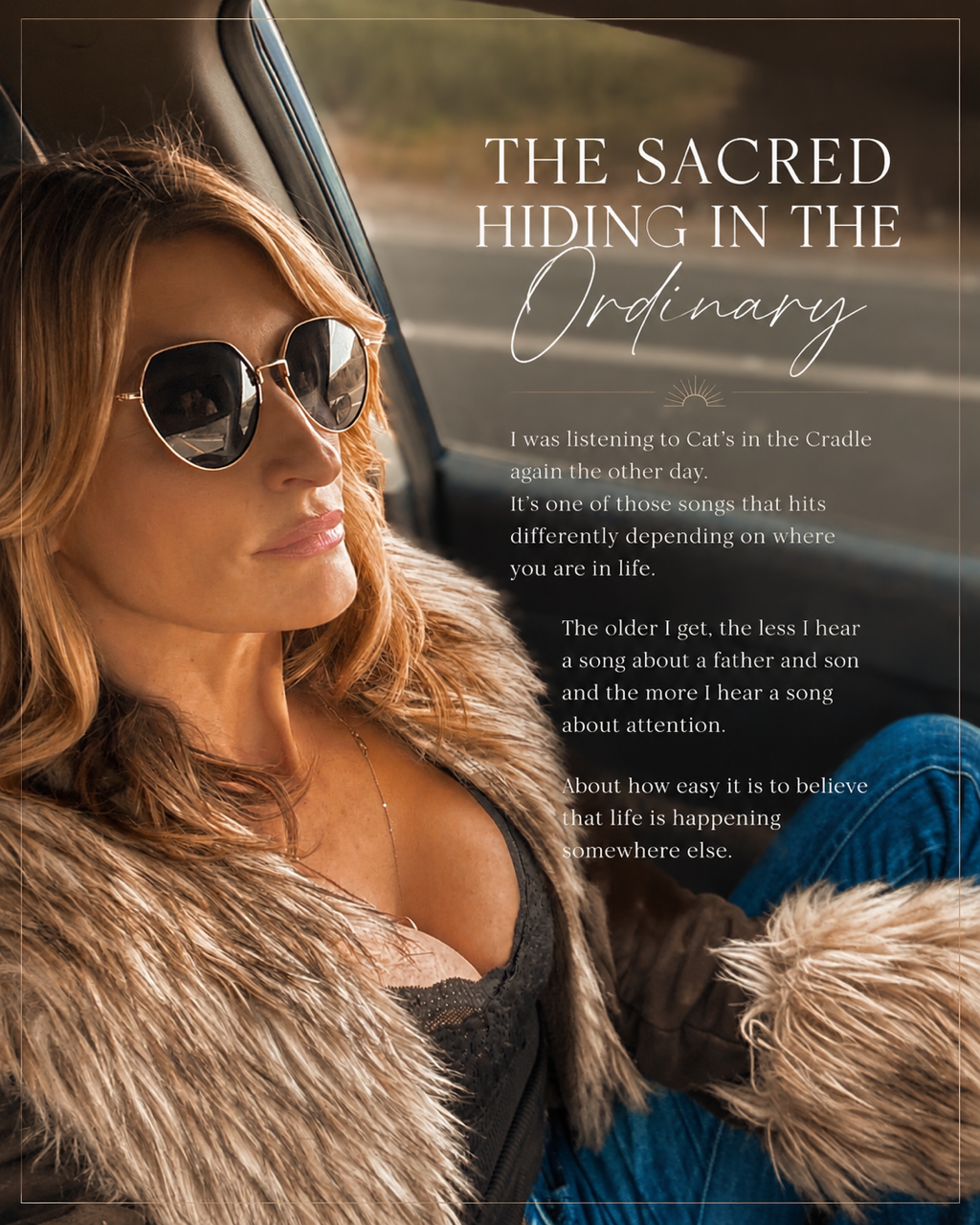
I was listening to Cat’s in the Cradle again the other day.
It’s one of those songs that seems to hit differently depending on where you are in life. Now, the older I get, the less I hear a song about a father and son and the more I hear a song about attention.
About how easy it is to believe that life is happening somewhere else.
The father isn’t a bad man. He loves his son. That’s what makes the song so heartbreaking. He just keeps believing there will be more time. That he’ll be more available after the next project, the next obligation, the next adventure that needs tending to.
And before he knows it, the moments he thought would always be there are gone.
I’ve been thinking about that a lot lately.
Not just because of the song, but because it feels like we’ve built an entire culture around that same premise. The constant temptation to look beyond what is right in front of us.
A better opportunity.
A better version of ourselves.
A better relationship.
A better destination.
A better tomorrow.
We are constantly being invited to peer over the fence, convinced the greener grass exists somewhere else. And not staying present with what is in the current moment.
And the irony, of course, is that once we arrive there, at the perceived greener pasture, another fence appears.
Another patch of grass.
Another promise.
Another distraction.
I catch myself doing it too.
Thinking life will feel more settled after this challenge passes. More abundant after the next check arrives. More peaceful after the next hurdle is cleared. As if fulfillment is perpetually waiting just beyond the horizon.
But horizons have a funny way of moving.
And while we’re busy chasing what could be, the life we’re actually living continues to unfold.
Unnoticed.
Uncelebrated.
Unattended.
I don’t think the greatest threat to the sacred is suffering.
I think it’s distraction.
Not the dramatic kind. The ordinary kind.
The endless scrolling.
The constant stimulation.
The need to fill every quiet moment.
The subtle belief that whatever is next must somehow be more meaningful than what is now.
We’ve become so accustomed to excess—of information, entertainment, options, and noise—that stillness can feel uncomfortable. Boredom has become something to avoid rather than something to move through.
Yet some of life’s most meaningful moments require exactly what modern life discourages: sustained attention.
The sacred rarely arrives with fireworks.
More often it slips into our lives disguised as the mundane.
A conversation in the kitchen.
Coffee shared before the day begins.
A child asking you to watch.
A partner reaching for your hand.
The familiar routines that quietly stitch a life together.
Maybe that’s why the ordinary becomes so easy to overlook. Familiarity creates a kind of blindness. We stop seeing what we’ve stopped noticing. Simply because it has been acquired and we are off and distracted by other things.
Until something changes.
Until a child grows up.
Until a relationship fractures.
Until someone moves away.
Until a season ends.
Until we realize that what we dismissed as ordinary was never ordinary at all.
I’ve wondered lately if part of the challenge isn’t finding meaning, but recognizing it.
Learning to see the masterpiece hidden inside the mundane.
Learning that presence and appreciation are not passive acts but practices.
Learning that boredom is often the threshold to deeper attention.
Because what if the sacred isn’t hiding from us?
What if it has been sitting in plain sight all along, waiting patiently while we searched for something more interesting?
The tragedy of Cat’s in the Cradle isn’t that the father failed to find what mattered.
It’s that what mattered was there the entire time.
Maybe that’s why the song still endures.
It reminds us of something we already know but are constantly at risk of forgetting:
What we call mundane is often just the sacred before we have learned to miss it.
And perhaps the measure of a life well lived is not how much we accumulated, achieved, or experienced, but how fully we were present for the treasures that were hiding in plain sight all along
